4.2× FASTER SHORTLISTING | 68% LESS RECRUITER EFFORT | 91% STUDENT MATCH ACCURACY |
Across India's Tier-2 and Tier-3 colleges, thousands of students graduate each year with strong skills but weak placement outcomes. Not because the talent isn't there — but because the process connecting them to opportunities is broken.
Training & Placement Officers (TPOs) spend weeks managing spreadsheets, chasing company contacts, and manually filtering applications. Recruiters wade through mismatched profiles. Students receive little guidance on where to apply or how to present themselves. The result: a high-effort, low-yield cycle that leaves everyone frustrated.
NeoNeev AI was built to break this cycle — not by adding another portal to log into, but by embedding intelligence at every step of the placement workflow.
The three bottlenecks killing placement efficiency
Before proposing solutions, it helps to be precise about where the time and effort actually disappears. In conversations with TPOs across Maharashtra, Uttar Pradesh, and Rajasthan, three bottlenecks emerged consistently.
1 | Discovery lag — companies never find the right colleges Recruiters default to the same 30–40 campuses they already know. Smaller colleges with equally talented students simply don't show up in their pipeline. The result is a structural supply-demand mismatch that no amount of cold calling fixes. |
2 | Matching friction — profiles aren't read, they're filtered out When a recruiter receives 400 applications for 8 roles, the instinct is to eliminate rather than evaluate. Students with non-linear backgrounds, relevant project work, or niche skills get dropped in the first pass. The best fit often never makes the shortlist. |
3 | Preparation gap — students don't know what 'ready' looks like Most placement prep is generic: attend a workshop, submit your resume, wait. Students rarely get role-specific guidance, real-time feedback on their profiles, or structured interview preparation tied to actual company expectations. |
"The problem isn't the students. It's the system that was never designed to surface them efficiently."
How NeoNeev's AI agents work — end to end
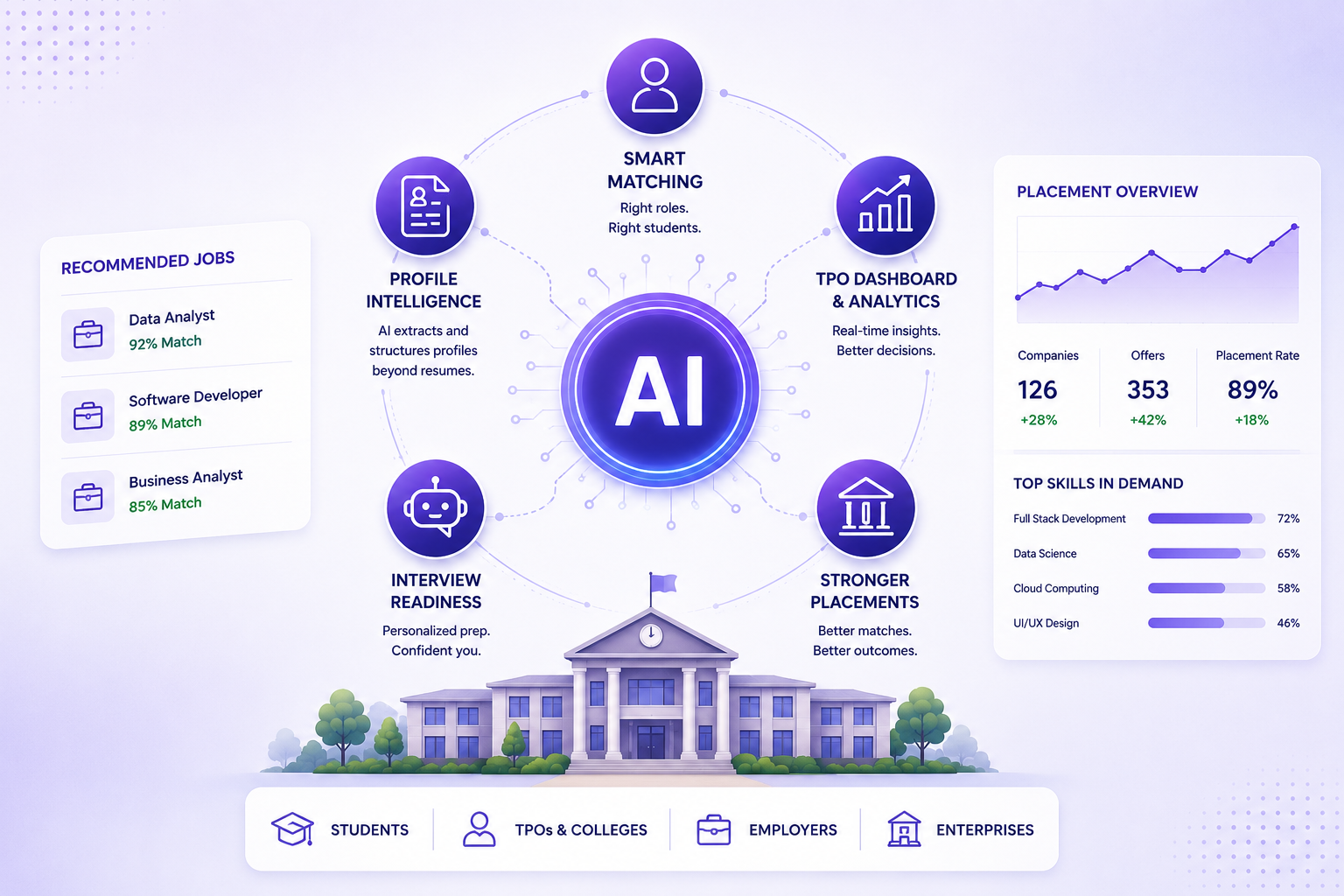
NeoNeev runs a multi-agent AI core across four portals: students, colleges (TPOs), employers, and enterprise. Rather than automating individual tasks, each agent handles a whole layer of the placement workflow — and they communicate with each other.
🔍 Smart profile builder AI extracts and structures a student's skills, projects, and academics into a dynamic, role-aware profile — not a static PDF. | ⚡ Intelligent job matching NeoNeev matches roles to students based on skill overlap, not just keyword hits — cutting shortlisting time by over 70%. |
🤖 Interview readiness agent Personalised mock interviews, gap analysis, and company-specific coaching — delivered conversationally, at scale. | 📊 TPO dashboard & analytics Real-time visibility into student readiness, recruiter engagement, offer pipelines, and placement outcomes — all in one place. |
For TPOs, the most immediate change is time. Tasks that previously consumed two to three weeks — coordinating company visits, filtering applications, communicating offer statuses — now run in the background. Placement officers shift from administrative work to high-value relationship building.
For students, the shift is equally significant. Instead of receiving generic advice from a single placement cell managing 2,000 students, each student gets a personalised readiness plan tied to the actual roles available. They know which skills to build, which companies are relevant, and how their profile compares — in real time.
What efficiency actually looks like at a Tier-2 college
Consider a college of 800 students running a placement season. Traditionally, the TPO would spend 3–4 months on outreach to 60–80 companies, manually process 15,000 applications across all drives, and coordinate logistics for 40+ selection rounds. Two staff members, working overtime.
With NeoNeev, the same placement office — same staff, same students — runs company outreach through an AI-assisted network, receives pre-screened candidate shortlists per role, automates scheduling and communication, and tracks placement status without a single spreadsheet. The season compresses from four months to eight weeks. Placement rates improve not because more companies are invited, but because the right companies see the right students.
Efficiency here isn't about replacing the TPO. It's about giving them the leverage to do what they're actually good at.
The data privacy foundation underneath it all
Student placement data is sensitive. Academic records, mental health indicators, financial status — these signals can influence career outcomes in ways students may not anticipate. NeoNeev is built DPDP Act-compliant from the ground up: granular consent for each data use case, hard-delete erasure on withdrawal, and PII scrubbing throughout the LLM pipeline. Students own their data. Recruiters see only what has been shared deliberately.
This isn't a checkbox. It's the foundation that earns institutional trust — and institutional trust is what drives adoption at scale.
Ready to transform your placement cell? Join the early cohort of colleges piloting NeoNeev AI. No long contracts — just measurable outcomes in your next placement season. Contact us: hello@neoneevai.com | www.neoneevai.com |
Tags: Campus placements · AI in education · TPO tools · Recruitment automation · Tier-2 colleges · India edtech